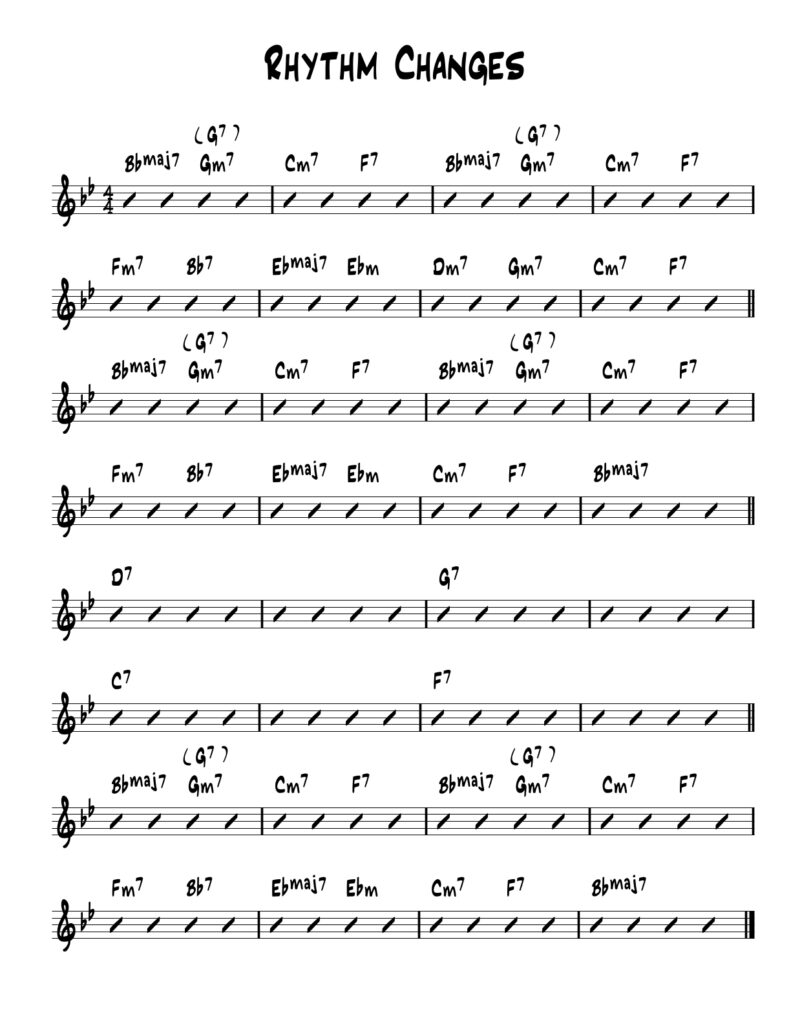
I remember when I was first learning to play jazz—hearing bebop for the first time was a revelation. Once I discovered Charlie Parker, I was hooked. I quickly started learning a few tunes, but I also remember how overwhelmed I felt trying to improvise over Rhythm Changes. It wasn’t just the speed—it was the rapid-fire chord movement that made it so challenging. Over time, I came to understand that the key to navigating these changes was learning to hear and see them as expressions of the key center, rather than as isolated chords. This realization led me to group chords together and focus on the broader concepts of tension and resolution.
In the “A” section, the critical movements are the G7 resolving to Cmi7, and the F7 resolving to Bbmaj7. The second phrase shifts to the IV and then to the minor iv.
The “B” section, while technically a III–VI–II–V progression, can feels like a series of four distinct keys, since each chord tends to imply its own Mixolydian mode. This gives the bridge a more fragmented, shifting character—even though it remains within one key center.
Thinking about the changes in this broader way gave me a stronger structural overview and ultimately freed me to focus on melodic direction and rhythmic interest.