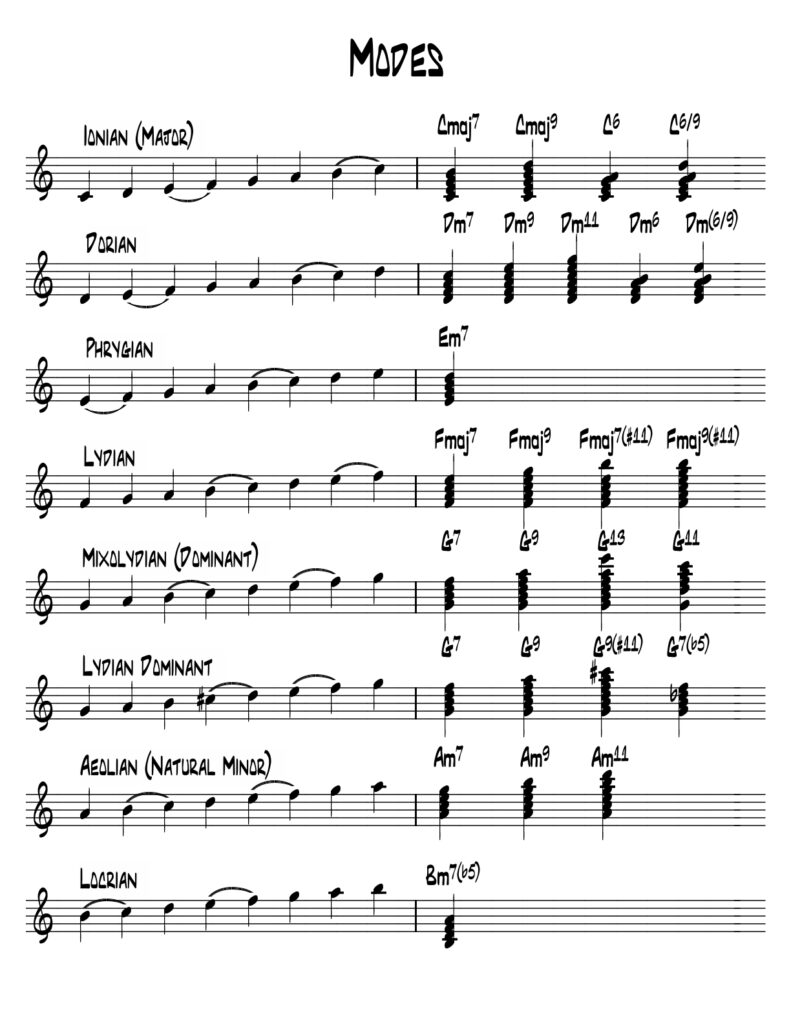
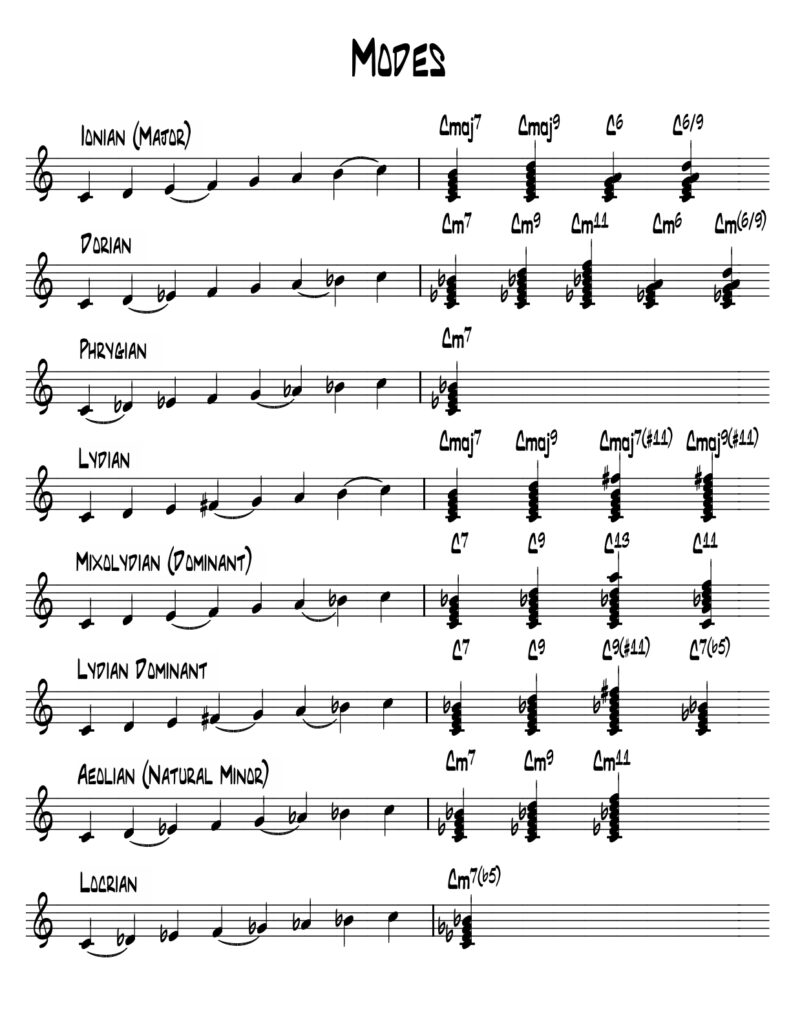
Understanding modes can be a challenge—not just to learn, but to teach as well. Through working with hundreds of students, I’ve developed what I believe is an effective way to visualize and internalize modes. As both a composer and an improviser, I think in terms of practical use. Theory alone has little value if it isn’t connected to real musical application.
On the first page, we see the common method of introducing modes: starting the C major scale on its second degree gives us D Dorian. While this is technically correct, it often leads to the misconception that C Ionian and D Dorian are essentially the same scale. Though they share the same notes, they create very different musical environments. This approach can become a shortcut that obscures the uniqueness of each mode.
On the second page, we compare C Ionian to C Dorian, C Phrygian, etc, all with C as the tonal center. This contrast reveals the distinct character of each mode. Here, the difference in half-step placement becomes especially clear, and we begin to see modes as independent tonal systems rather than mere reconfigurations of a parent scale. Recognizing where the half steps are not only an effective way to configure and identify the mode but are invaluable in composing and improvising in each mode.
The chords shown are common harmonic representations of each mode. These provide a practical framework for hearing and understanding the qualities in each mode.